How to Build a Standing Desk Habit That Actually Sticks
You bought the standing desk. The first week was great: you stood through meetings, raised the desk every morning, and felt a little more awake in the afternoon. Then a busy week came along, and the desk went down. It's been in the sitting position ever since.
If that sounds familiar, you're in good company. A standing desk that stays at sitting height is one of the most common stories in office ergonomics. The good news is that this isn't a motivation problem, and it isn't a character flaw. It's a habit design problem, and habits can be designed.
This guide covers why standing desk habits fade, the principles that make new habits stick, and a simple 4-week plan to make changing position a normal part of your workday.
Why Most Standing Desks End Up in the Sitting Position
When people stop using their standing desk, it's rarely because they decided standing wasn't worth it. It usually happens for a handful of predictable reasons:
- There's no trigger. Nothing in your day says "now is the time to stand." So the decision is left to memory, and memory loses to deep focus every time.
- The first attempts were too ambitious. Standing for two or three hours on day one leads to sore feet and tired legs, and your brain quietly files standing under "uncomfortable."
- Friction adds up. A desk without preset heights, a cable that gets caught, a stack of papers on a shelf that has to move first. Every small obstacle makes "later" more likely.
- One bad week breaks the chain. Travel, a deadline, or a cold interrupts the routine, and there's no plan for getting back on track.
Notice that none of these are about knowing why you should stand. Most people already know that sitting all day isn't great for their back, energy, or circulation (if you want a refresher, see our guide to standing desk health benefits). Knowing isn't the bottleneck. Doing is.

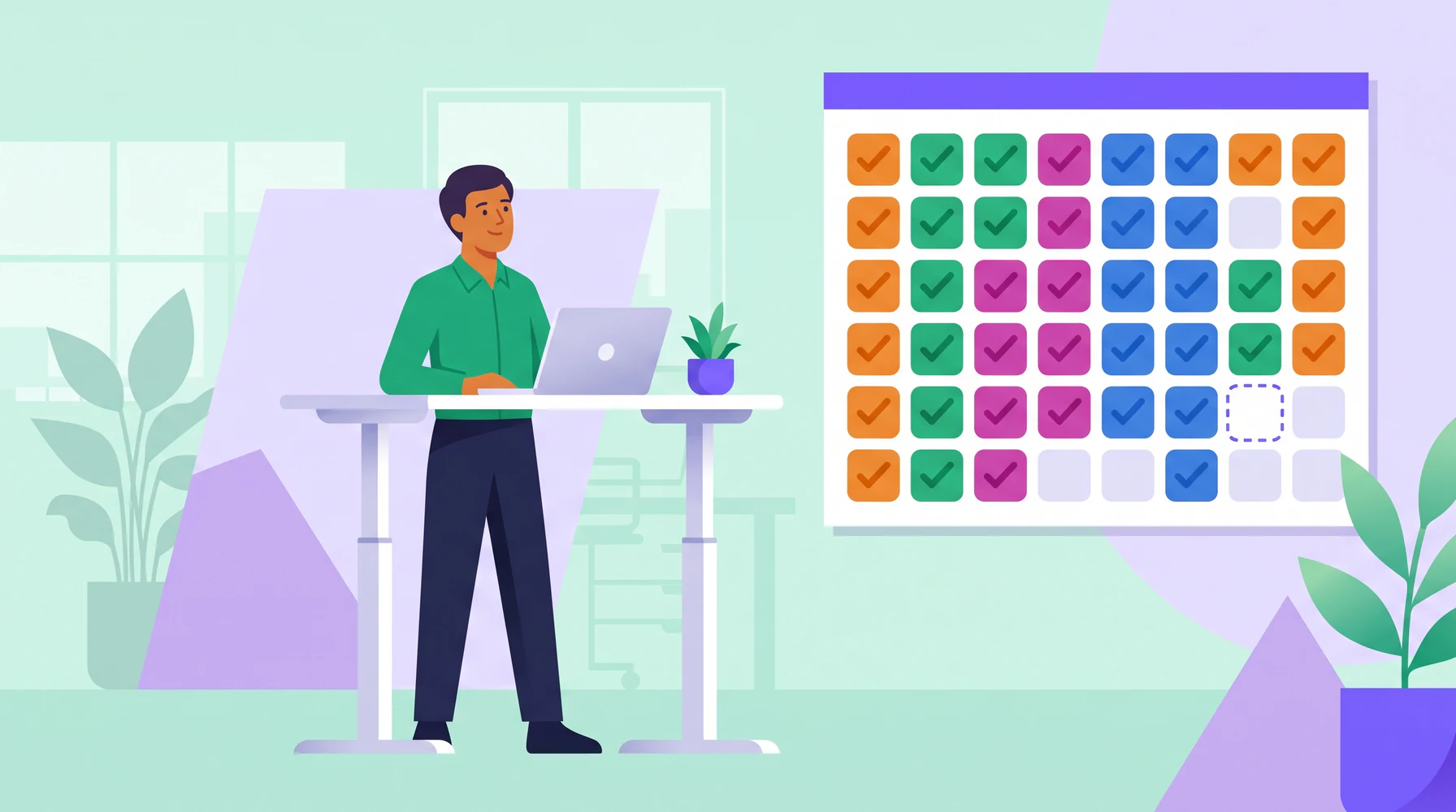
Photo by TheStandingDesk on Unsplash
Habit Building Principles That Work for Standing Desks
Popular habit research, like BJ Fogg's Tiny Habits and James Clear's Atomic Habits, points to a few ideas that apply perfectly to sit-stand routines.
1. Every habit needs a cue
A habit is a behavior that runs on autopilot after a specific trigger. Brushing your teeth follows waking up. Grabbing your keys follows putting on your shoes. For a standing desk habit, you need something equally clear: a moment that reliably says "stand up now."
2. Make it easy, then make it bigger
The smaller the starting behavior, the more likely you are to repeat it. Standing for ten minutes is easy. Standing for two hours straight is not. Start with a version of the habit that feels almost too small, and grow it once it's automatic.
3. Stack it on something you already do
Habit stacking means attaching a new behavior to an existing routine: "After I do X, I will do Y." Your workday is full of anchors (calls, coffee, lunch, checking email) that can carry a posture change with them.
4. Shape the environment
It's easier to change your surroundings than to rely on willpower. If the right action is the easiest action, you'll take it far more often.
External Cues Beat Willpower
Here's the core insight for anyone trying to stop sitting all day: you cannot rely on remembering to stand. When you're focused, time disappears. An hour feels like fifteen minutes, and by the time you notice your stiff back, you've been sitting all afternoon.
The fix is an external cue that doesn't depend on your attention. A timer is the simplest version: it tracks time while you do your work, and it tells you when it's time to change.
This is exactly why we built Standflow. It lives in your Mac's menu bar and runs your sit-stand routine for you, with customizable intervals for sitting, standing, perching, and moving. You can reorder them however you like, or start from a preset:
- Easy Start: a gentle 30-minute cycle, ideal for your first weeks.
- Balanced: a 60-minute cycle once standing feels natural.
- Posture Trio: a 90-minute cycle that adds perching and moving.
One feature matters a lot for habit building: the "ask me first" mode. Instead of switching automatically, Standflow waits for you with a compact alert. If you're in the middle of a sentence, you can stay a few more minutes or get reminded in 5 minutes, so the cue bends around your work instead of breaking it. A reminder that respects your focus is a reminder you'll keep turned on, and that's what makes a habit last.
A 4-Week Plan to Build Your Standing Desk Habit
The biggest mistake with a new standing desk is doing too much, too soon. This plan ramps up gradually, so your body adapts and the routine becomes automatic before it becomes demanding. Adjust the numbers to how you feel; the shape of the plan matters more than the exact minutes.
| Week | Focus | What to do |
|---|---|---|
| 1 | Build the cue | Stand for short blocks (around 10 minutes) a few times a day. Use a timer so you don't have to remember. Don't worry about totals. |
| 2 | Add anchors | Keep the short blocks and add one or two anchored stands, like taking calls standing or standing for the first part of your morning. |
| 3 | Introduce movement | Lengthen standing blocks a little if they feel comfortable, and add a short movement break (walk, stretch, refill your water) to each cycle. |
| 4 | Find your rhythm | Settle into a regular cycle that alternates sitting, standing, and moving throughout the day. Keep what works, drop what doesn't. |
A few notes on the plan:
- Discomfort is a signal, not a challenge. If your feet or lower back ache, sit down. Standing longer through pain doesn't build the habit; it builds a reason to quit.
- Alternating is the goal, not standing. The aim isn't to stand all day. It's to avoid long, uninterrupted stretches in any single position. If you're not sure how to split your time, our guide to the best sit-stand schedule walks through a few options.
- Movement counts. Short walking or stretching breaks are often the part people enjoy most once they try it. Our desk stretches and mobility routine gives you ideas for those minutes.
Anchor Posture Changes to Moments You Already Have
Beyond timers, the most reliable cues are events that already happen every day. Pick two or three and attach a posture change to each:
- Calls and video meetings → stand. Many people find they speak with more energy on their feet. Raise the desk before you join.
- After lunch → walk. Even a short walk after eating is an easy, pleasant habit, and it's a natural counter to the post-lunch slump.
- Morning coffee → stand for the first block. Starting the day standing sets the tone and makes the next change feel normal.
- Finishing a task → change position. Completing a ticket, sending a draft, or closing a pull request is a natural break point.
- Refilling your water → take the long way. It's a built-in movement break with a purpose.
The format is always the same: "When X happens, I change position." The more specific the anchor, the better it works. For example, "when I join a call" is better than "sometimes during calls." For more ideas on fitting movement into focused work, see our post on movement breaks for focus and productivity.
Design Your Environment for Standing
Every bit of friction you remove makes the habit more likely to happen on a busy day. Spend fifteen minutes setting things up once:
- Save preset heights. If your desk supports memory presets, store your sitting and standing heights so changing position is one button, not ten seconds of adjusting. (Not sure what heights to use? Our standing desk ergonomics setup guide covers it.)
- Keep the mat in place. An anti-fatigue mat that lives under the desk gets used. One stored in a closet doesn't.
- Clear the path. Make sure nothing blocks the desk from rising: no drawers, shelves, or stacked boxes underneath, and enough slack in your cables.
- Keep comfortable shoes nearby. If you work from home, a pair of supportive shoes or slippers makes standing much more pleasant than bare feet on a hard floor.
- Make sitting slightly less automatic. Some people push their chair a little away when they stand, so it isn't the default the moment they get tired.
Handle Bad Days: Never Miss Twice
Every habit has off days. You'll have a deadline, a long travel day, or simply an afternoon where you forget everything. That's normal and it's fine.
A helpful rule is never miss twice. One missed day is an accident; two in a row starts a new pattern. If yesterday was all sitting, today's job isn't to make up for it. It's just to do the smallest version of your routine: a couple of short standing blocks and one walk.
It also helps to keep a minimum version of the habit for hard days. On a packed day, maybe your only goal is "stand for every call." That still counts, and it keeps the chain intact.
The Monday reset
Weekends and holidays are where routines often break. A simple fix is a Monday reset: start each week with your timer running from the first hour of work, and stand for your first block before opening email. It takes no extra effort, and it puts the habit back on track before the week gets busy.
How to Tell Your Standing Desk Habit Is Working
You don't need perfect data to know whether the habit is taking hold. Pay attention to how you feel:
- End-of-day stiffness in your back, neck, or hips is milder or shows up less often.
- Afternoons feel less heavy. Changing position often helps break up the post-lunch slump.
- You change position without thinking about it. You raise the desk when a call starts, or you walk after lunch, without deciding to.
- Missing a cycle feels odd. When the routine is gone, you notice.
That last one is the real sign: when standing up feels like the default rather than an effort, the habit has stuck.
Frequently Asked Questions
How long does it take to build a standing desk habit?
It varies a lot from person to person and depends on how simple and consistent the routine is. Many people find that the routine starts to feel natural after a few weeks of steady practice, and that it becomes more automatic over the following months. Starting small and using a timer speeds things up.
Why do I keep forgetting to use my standing desk?
Because focus pushes everything else out of your mind. Forgetting isn't a lack of discipline; it's how attention works. Relying on an external cue, like a timer in your menu bar or an anchor such as "stand for every call," removes the need to remember.
How long should I stand when I'm just starting?
Start with short blocks, around 10 to 15 minutes at a time, a few times a day. Increase gradually as your legs and feet adapt. Alternating positions often is more important than standing for a long time.
What should I do if standing makes my feet or back hurt?
Sit down and shorten your standing blocks. Check your setup: desk height, monitor height, footwear, and an anti-fatigue mat all make a difference. If pain persists, talk to a healthcare professional.
Is it okay to skip days?
Yes. Missing a day doesn't undo your progress. Just avoid missing two days in a row, and fall back to the smallest version of your routine on busy days.
Conclusion: Make Standing the Easy Choice
A standing desk habit doesn't stick because of motivation. It sticks because the cue is clear, the first step is small, and the environment makes standing the easy choice. Start with short blocks, anchor them to moments you already have, let a timer do the remembering, and give yourself a few weeks to grow the routine.
Before long, getting up from your chair won't be something you have to decide. It'll just be part of how you work.